Testing nine creatures with rigs suited to their bodies.
We tested existing models of nine creatures with research rigs and UniMate motions suited to their bodies, then reimported the exports to inspect deformation. The hedgehog did not curl into a ball, and the golem’s foot contact was unstable; these remain research candidates without Unity, VR or release approval.
캐릭터팀 인턴 — 크리쳐 디자인
This episode stars · 캐릭터팀 인턴 — 크리쳐 디자인
We asked a hedgehog for a curl and a golem for a heavy step. They were never going to take the same instruction the same way. For each of nine existing models, we looked at the body parts that actually move, such as wings, tails or legs, and prepared a research rig to suit.
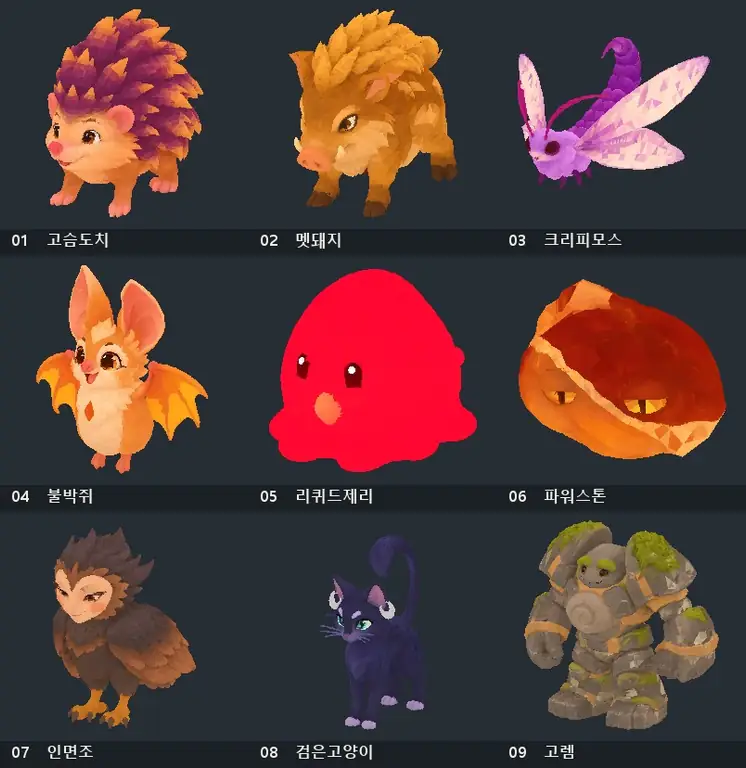
Nine models and their research rigsA contact sheet of the actual research models used in the rigging study.
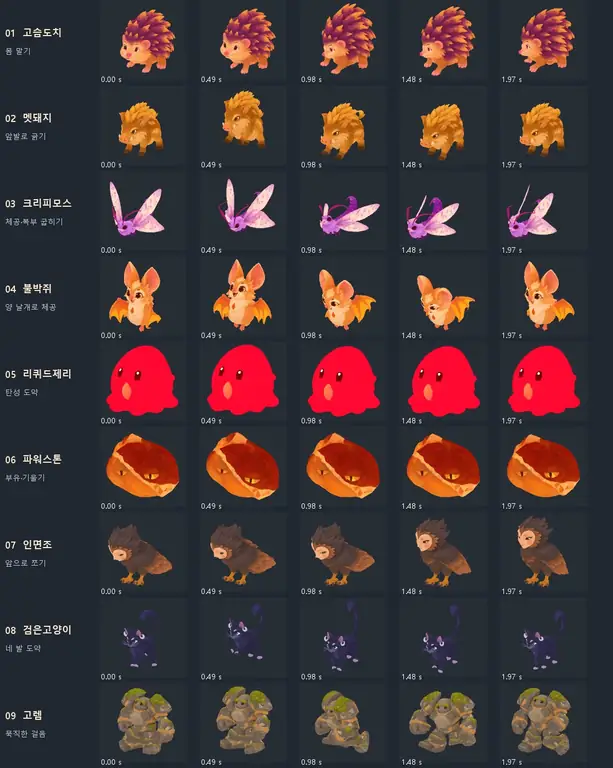
UniMate produced a short clip for each creature, and we compared how the meshes changed across frames. The fire bat tipped its body as the wings opened and closed. The hedgehog turned its neck and lifted its forefeet without reaching a ball shape. The golem shifted its weight from side to side, with uneven foot contact.
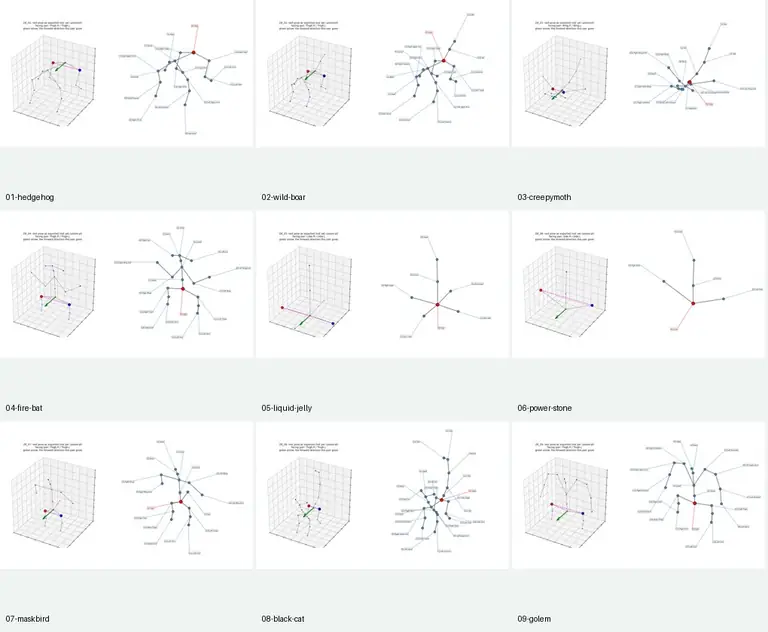
Facing direction and joint annotationWorking board for checking each creature’s facing direction and joint labels before motion generation.
We reimported the exports into an empty Blender scene and checked the bones and actual vertex movement. The FBX files were packaged with the missing original metallic and roughness maps reconnected. This set stays in research. A full curl likely needs a separate shape for the hedgehog, and the golem needs another pass on foot contact.
Frame comparisons from the motion exportsSampled frames from the research GLBs, before engine and release checks.
Based on actual work; expressions and robot scenes are dramatized. Actual work captures are labelled separately from illustrations.