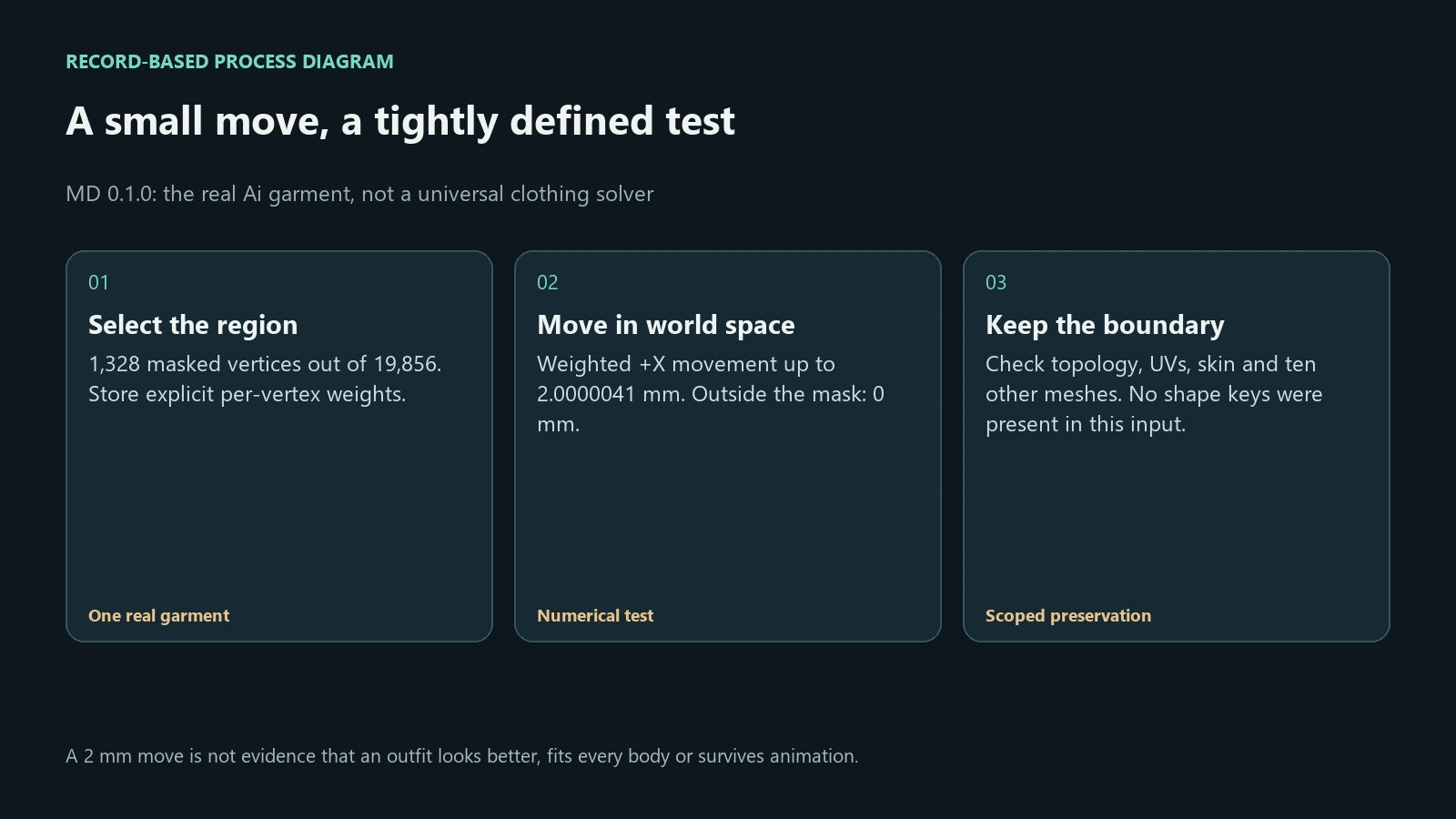
The clothing specialist asked where MD 0.1.0 could be useful today. Before asking a whole cape to flutter, the pipeline lead moved one region of the real Ai garment by 2 mm. Of its 19,856 vertices, 1,328 received explicit weights; the area outside the mask was meant to stay still. The maximum measured movement was about 2.0000041 mm, with zero outside-mask movement. This particular region moved as requested. Two millimetres sounds modest, but leaving the rest of the outfit alone comes first.
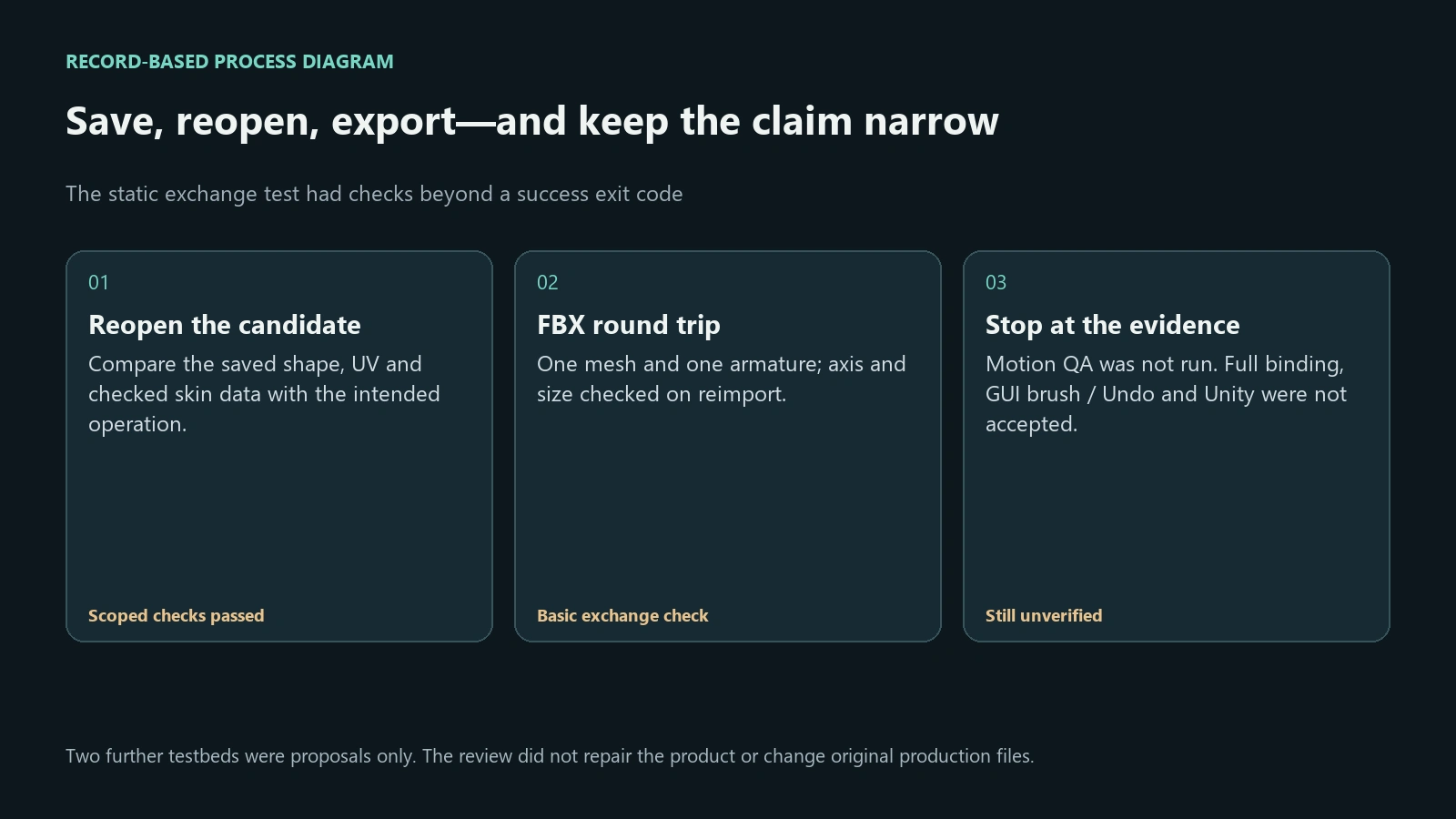
The candidate was saved and reopened to compare its shape, UVs, checked skin data and other meshes. An FBX reimport also checked basic axis and size consistency. That did not establish full binding or motion approval. This real-garment input had no shape keys, and Motion QA was not run. Two further testbeds remained proposals. The gray diagnostic renders were inspected privately; the diagrams explain the scoped test without dressing them up as finished outfit photography.
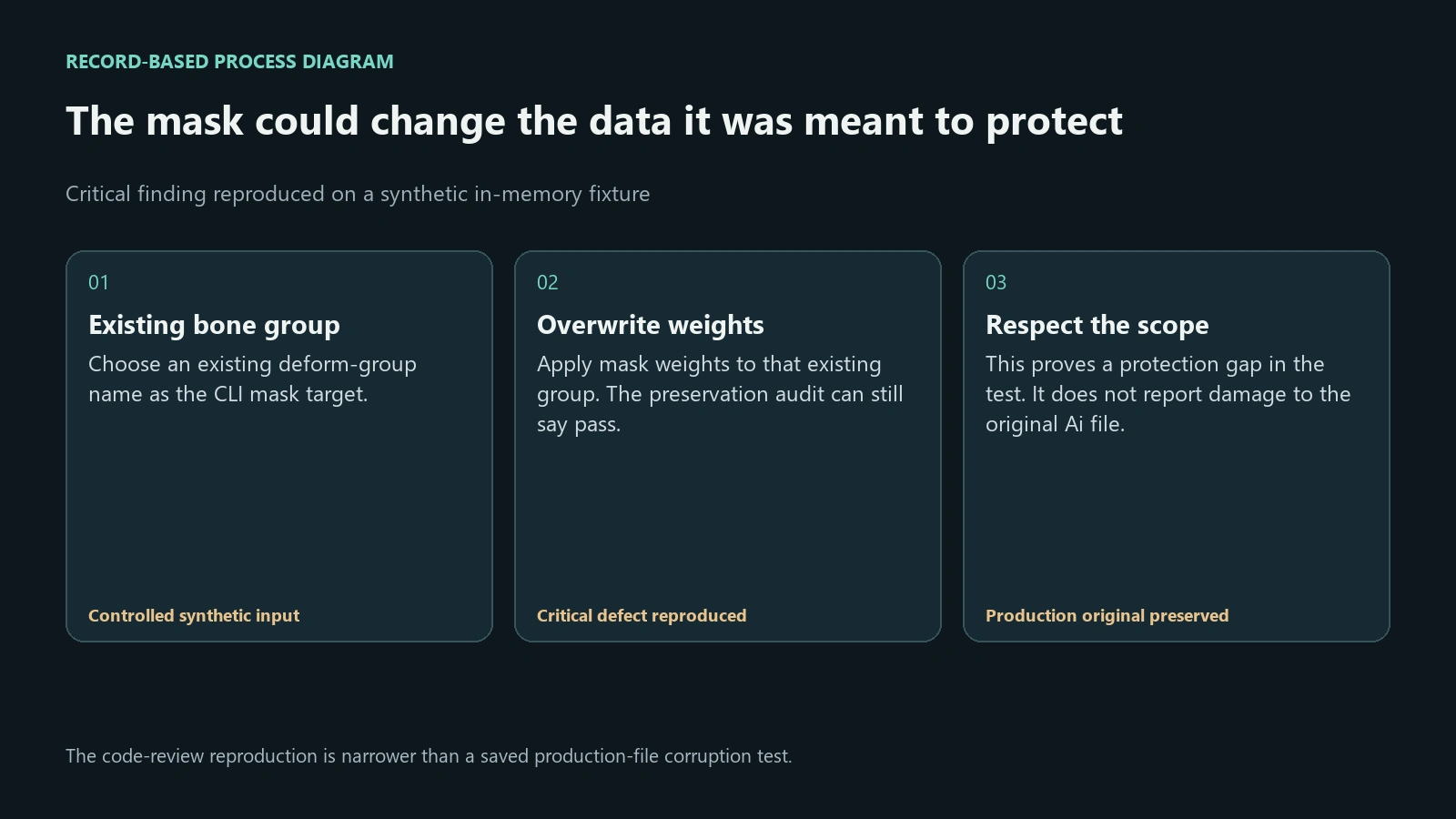
After the Art Director’s review, consultant Claude inspected the code and found reasons to inspect the success label itself. On a synthetic object, an existing bone-weight group could be selected as a mask and overwritten while the preservation audit still passed. A separate candidate could also inherit another candidate’s QA record. This is not a story about a damaged Ai production file. The critical protection gap was reproduced on a synthetic in-memory fixture, while the production original stayed preserved. A label reading “pass” does not get to skip inspection.
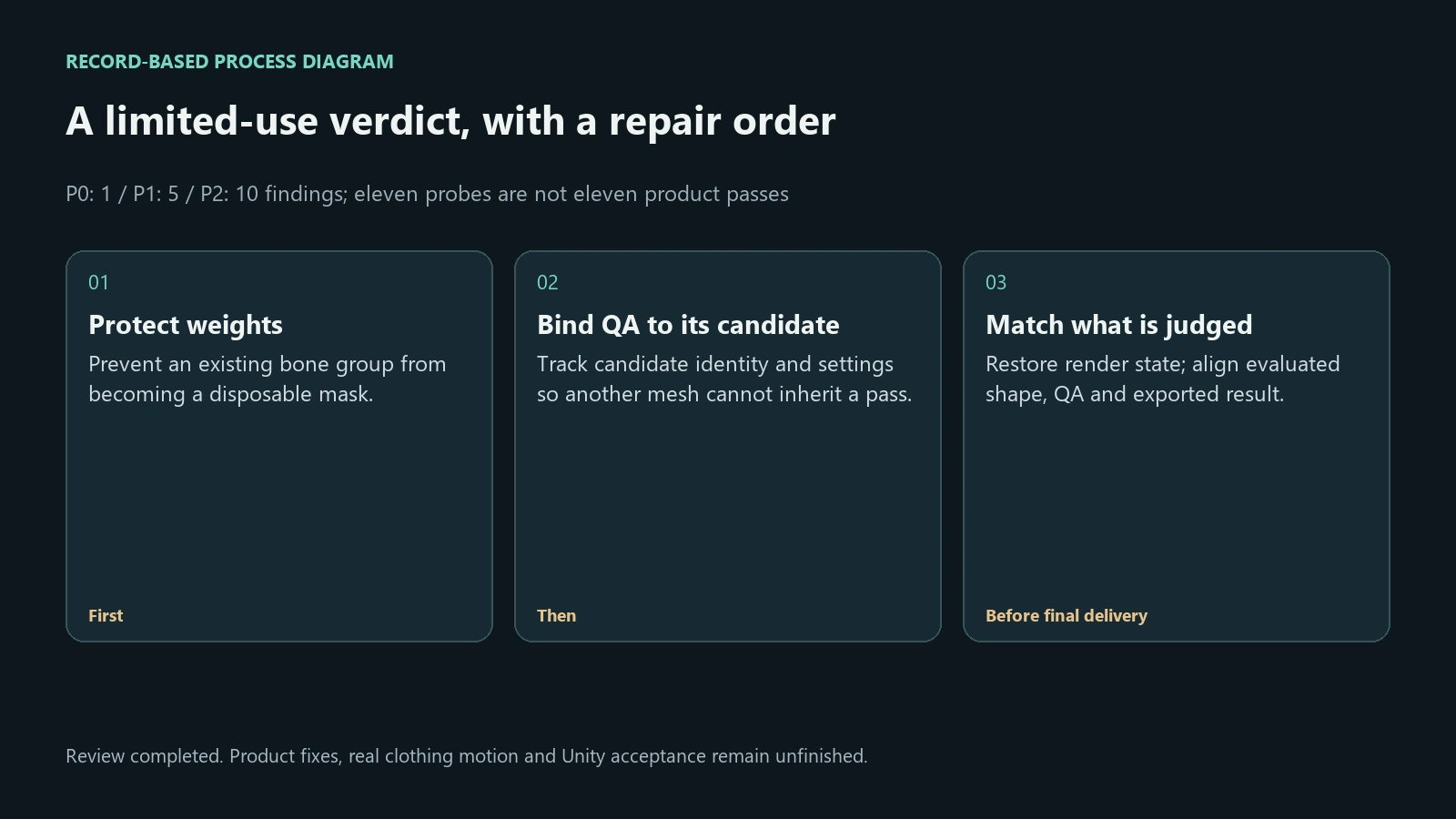
The final classification was one P0, five P1 and ten P2 findings, with a limited-use verdict. The repair order starts with protecting existing weights, then binding QA to the exact candidate and settings, then aligning render state, evaluated shape and export. Review and handoff finished; product fixes did not. The clothing specialist, pipeline lead, Art Director and consultant checked different layers of the same job. The move was 2 mm. The responsibility around it was considerably larger.