
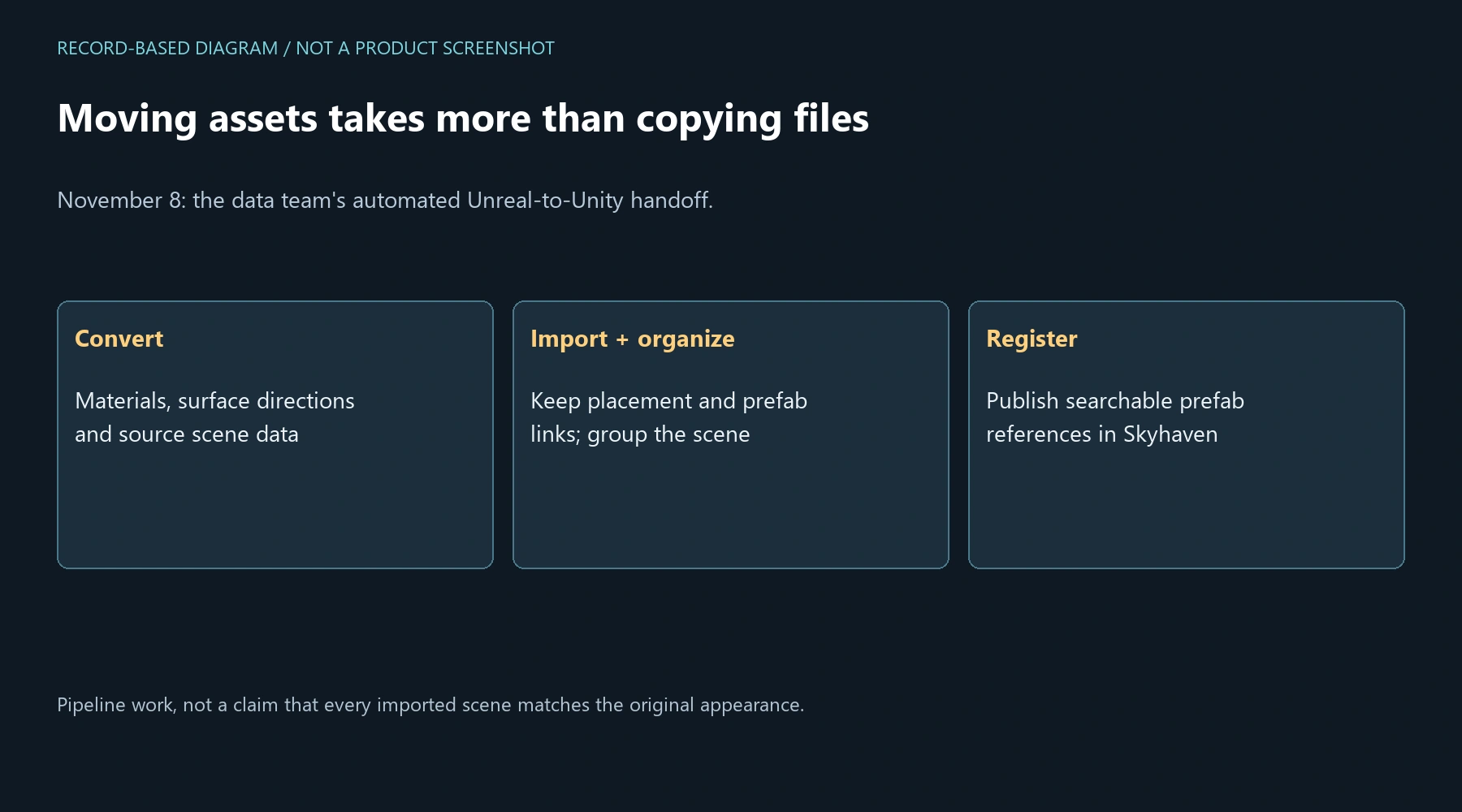
Moving resources sounds like a copy-and-paste job. Moving a village from Unreal to Unity brings rather more luggage: materials, the directions that surfaces use to receive light, scene placement, and an address the next person can find. On November 8, the Skyhaven resource owner on the data team worked on connecting that journey into an automated pipeline.
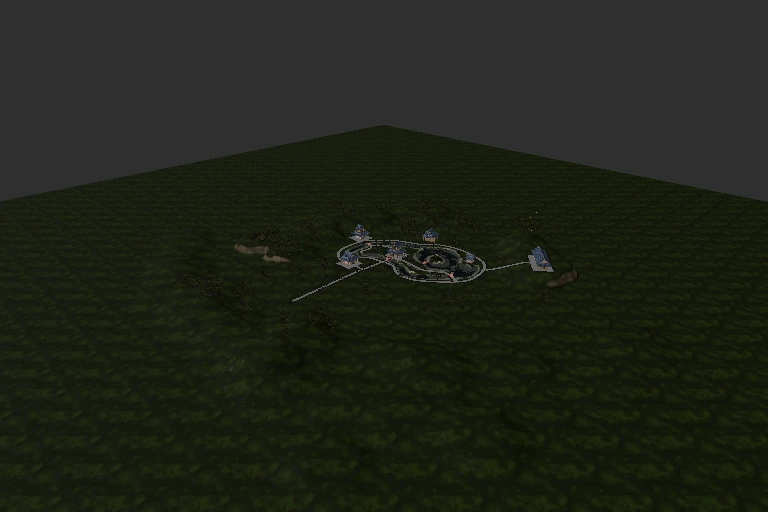
The initial checks established that shaders and their controls were assigned. They did not establish a visual match. A color-only view showed pink leaves; under lighting, the foliage and bark became almost black. The files had arrived. The cherry tree was looking distinctly unwell. A distant automated overview could not certify the colors either.
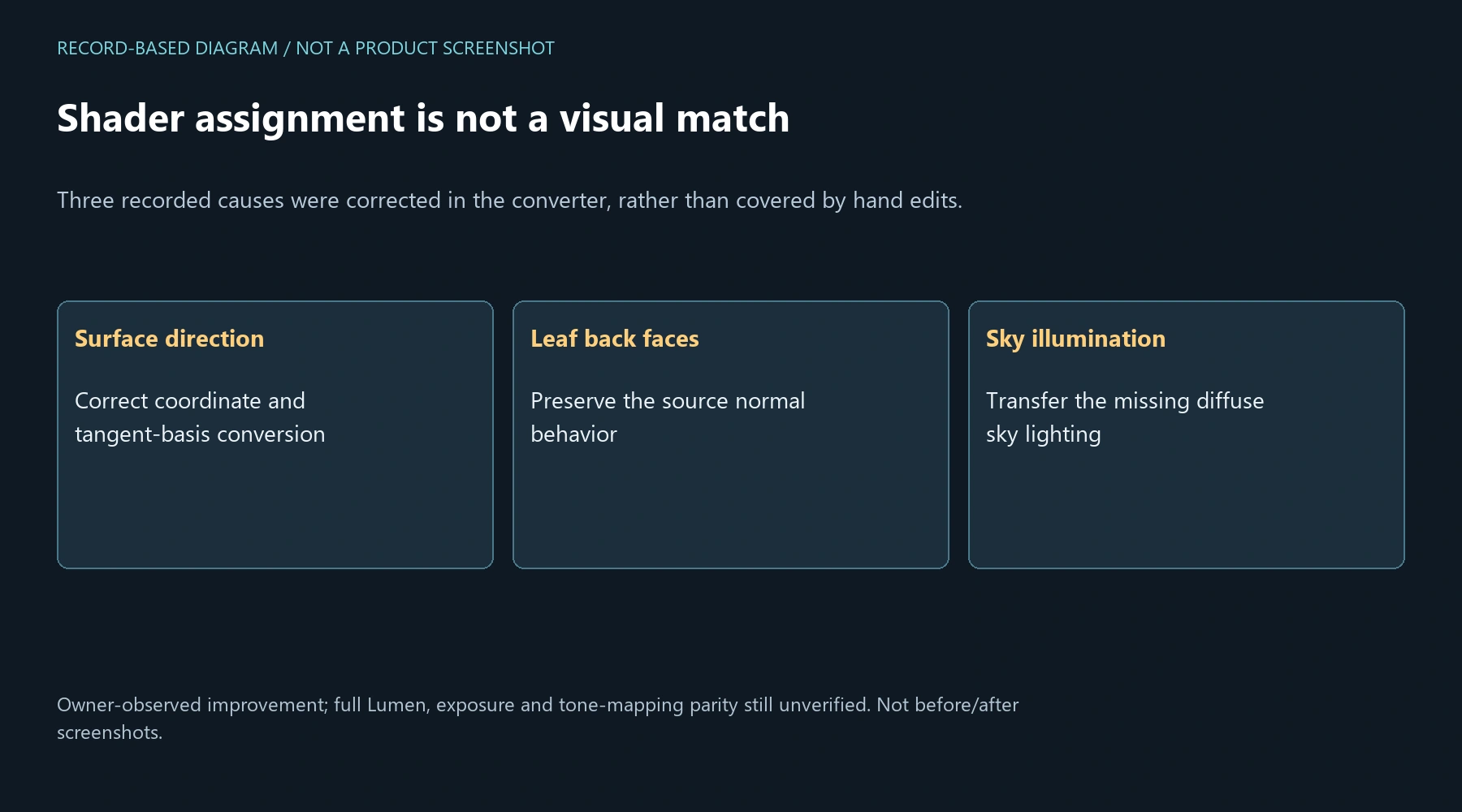
Tracing the problem revealed three causes: coordinate conversion of normals, which tell a surface how to receive light; unnecessary reversal of back-face leaf normals; and missing sky illumination from Unreal. Rather than repainting the leaves by hand, the owner corrected those three paths in the converter itself.
The owner reported checking the actual Unity view: previously black leaves looked pink again, and shaded building surfaces became brighter. The saved verification also showed that existing placement and unsaved edits were preserved. We did not obtain a matched before-and-after capture pair for this article. The figure below explains the recorded fixes; it is not a newly invented visual comparison.
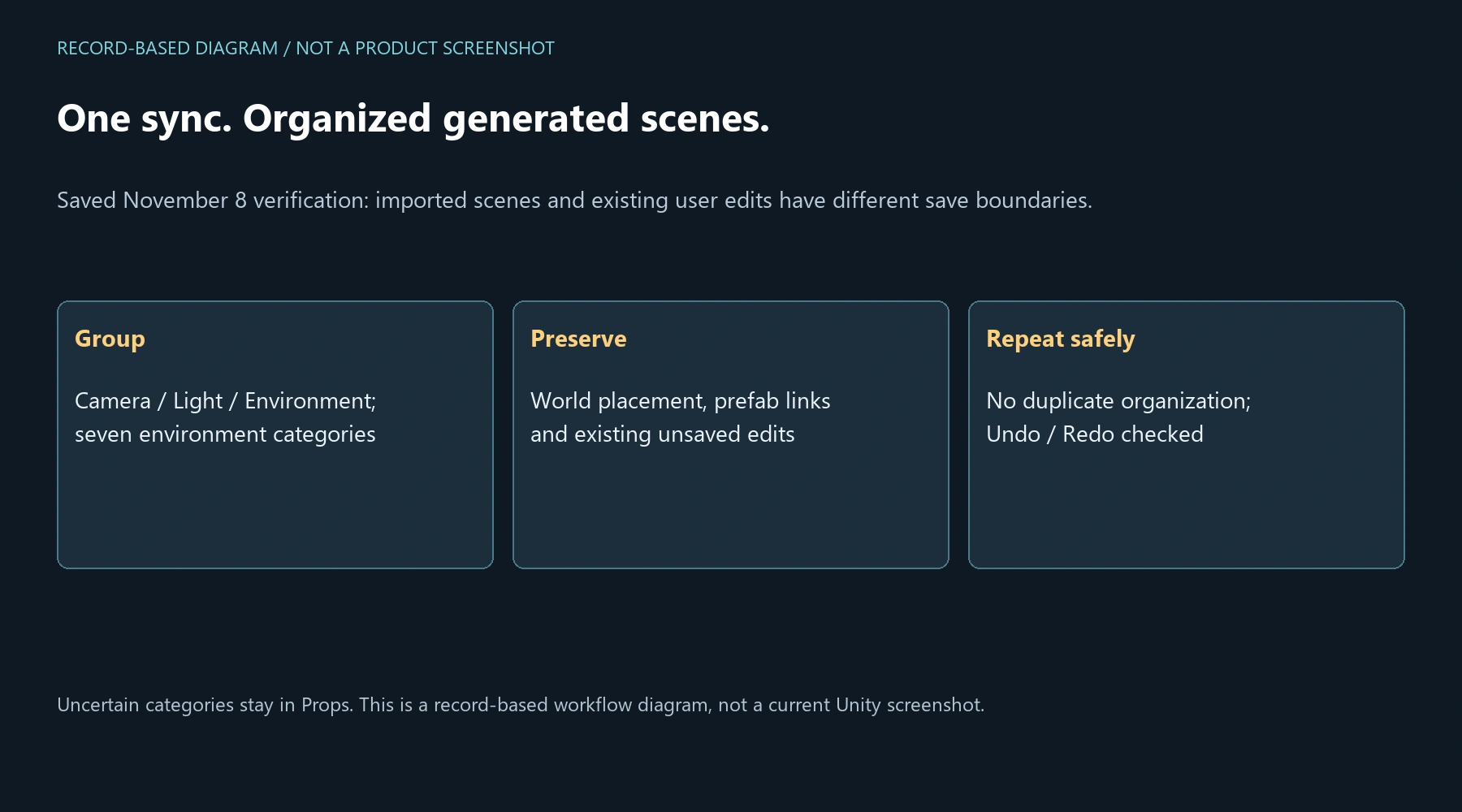
Scene organization became part of the automation too. Camera and Light sit alongside Environment, whose folders separate roads, foliage, buildings, terrain, water, props and effects. Ambiguous items stay in Props, and prefab hierarchies are kept intact. Sorting folders should not move the buildings around. That would be another relocation, not tidying.
The work went beyond a separate organization button. Sync Selected and Sync Now now feed import, automatic classification and saving of generated scenes. Asian Sanctuary was used to check repeat runs, duplicate prevention, Undo and Redo, and preserved prefab connections. The workflow also distinguished a newly generated scene from the user's already-open scene with unsaved edits.
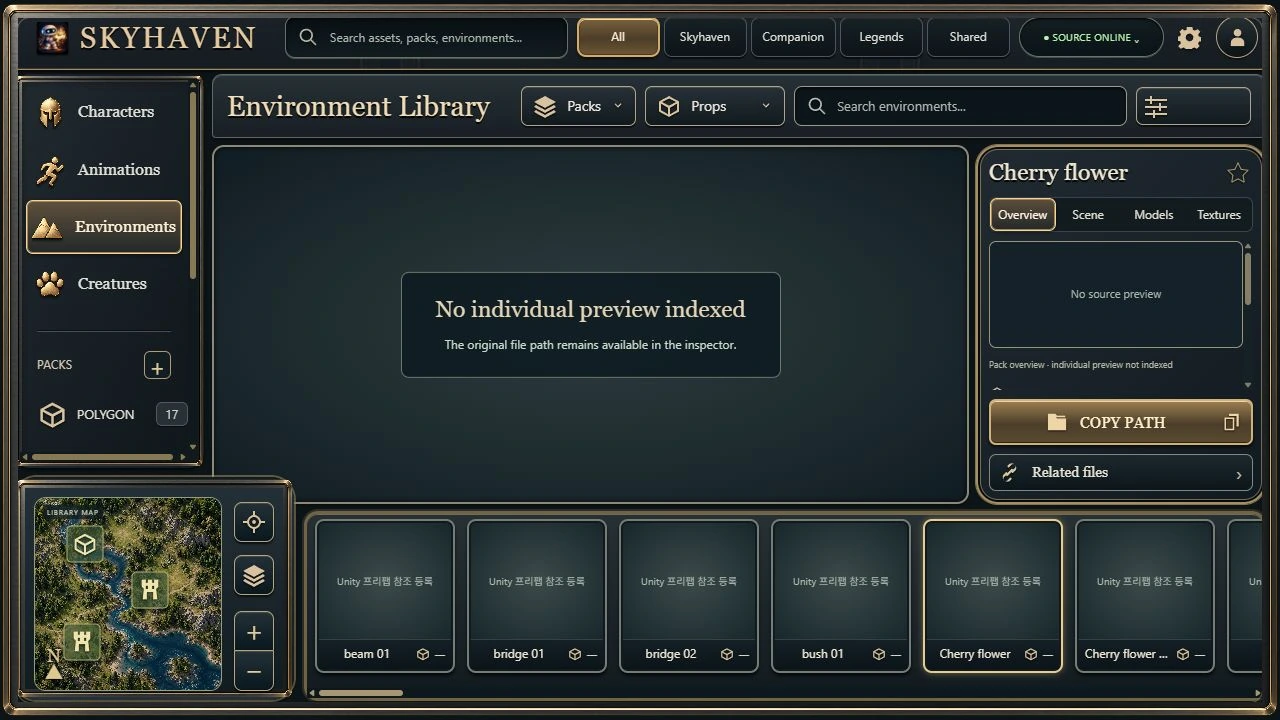
The day's closing record showed 21 packs synchronized and 1,937 prefab entries published in Skyhaven, reachable through creator, pack, then Props / prefabs. Those are November 8 catalog counts, not a count of models that passed visual review. The captured public page still explicitly says that individual 3D previews are not indexed.
Work remained. The result did not reproduce the source's full Lumen indirect lighting, exposure or tone mapping. The final action to reopen the Unity editor was refused by automatic approval review and remained incomplete, separately from the sync and catalog checks already finished. The data team's job was more than stacking boxes in a warehouse. It was making a route the next person could actually use.