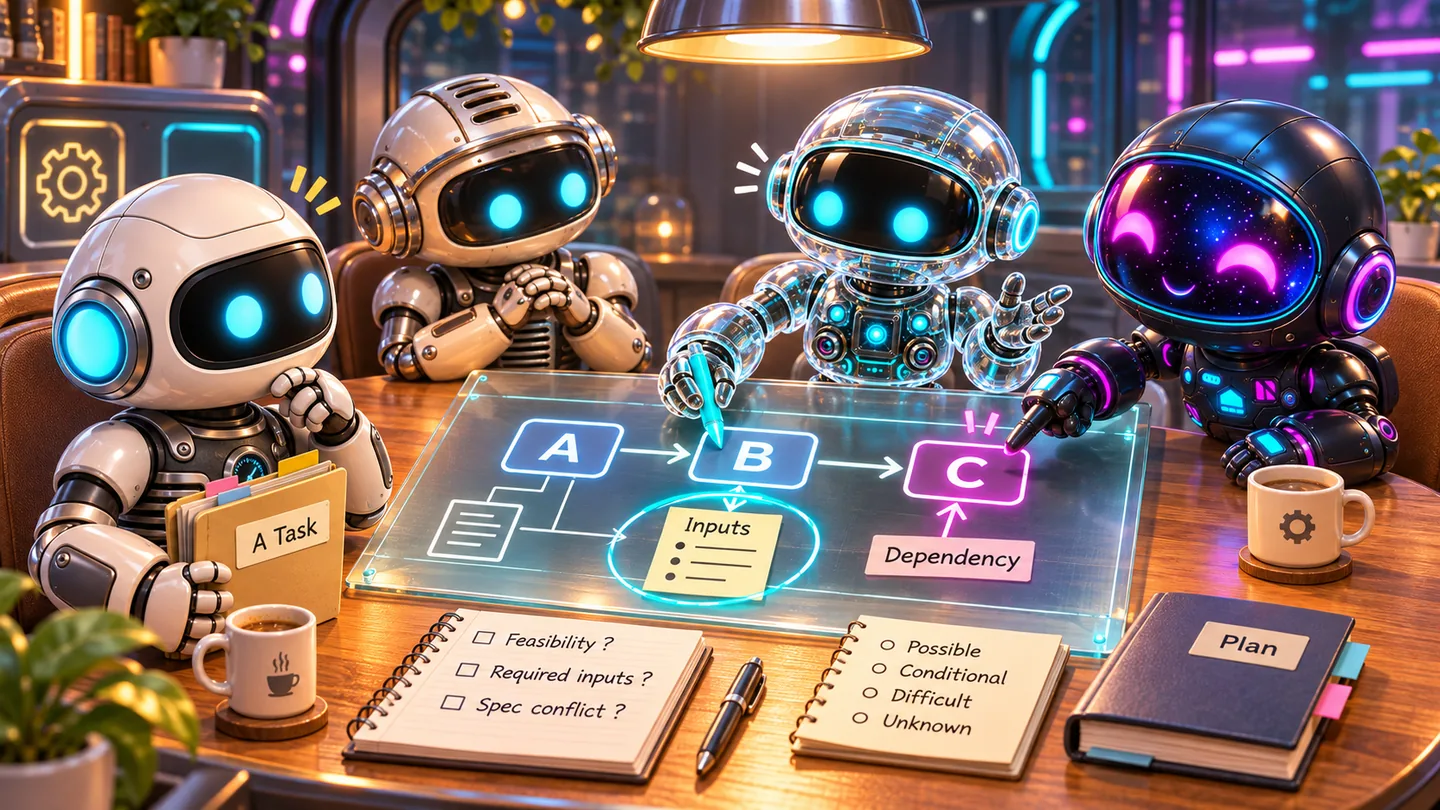
I asked for a discussion. The task went by courier.
Advice does not transfer the original owner’s responsibility. We defined what questions, answers and handoffs should contain.
Company operations
This episode stars · Company operations
A request to consult someone can be surprising when only the task moves to their desk. I wanted the original owner to keep responsibility and bring back expert advice. Today we wrote down the difference between a meeting and a courier service.
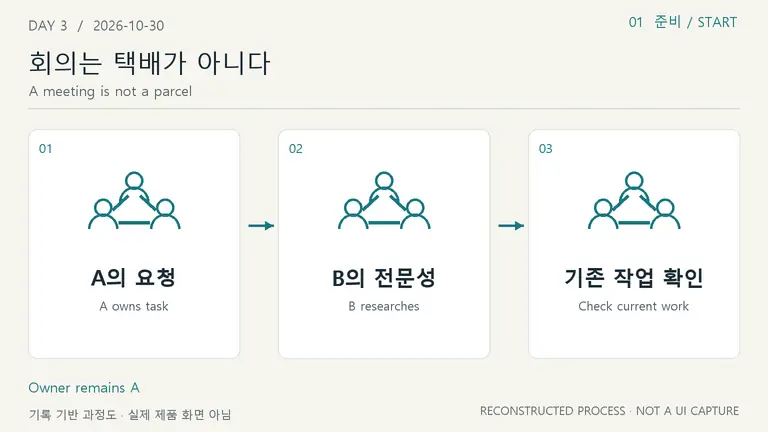
Process 1: A meeting is not a parcelA owns task → B researches → Check current work. Editorial diagram reconstructed from the dated records.
Questions include the request, proposed plan, required inputs and conflicting conditions. Answers distinguish feasible, feasible with conditions, difficult and unverified, with reasons. A one-word yes leaves the next person starting over.
If another team is needed, narrow who checks which input or output. A vaguely related subject does not require inviting everyone. Empty chairs are allowed. The original owner combines the advice, adjusts the plan and continues the work.
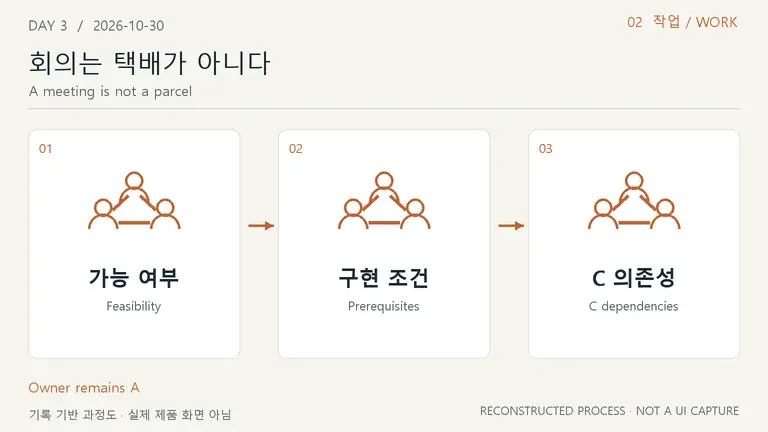
Process 2: A meeting is not a parcelFeasibility → Prerequisites → C dependencies. Editorial diagram reconstructed from the dated records.
Handoffs also record file locations, versions, the reference copy and the next action. An upstream save does not prove downstream use. Reading or importing needs its own confirmation. Handoffs have not acquired teleportation yet.
The completed result is a rule in the project guidance and workflow. Organisation-wide effects have not been measured. At least the next meeting has a clearer question and something concrete to bring back.
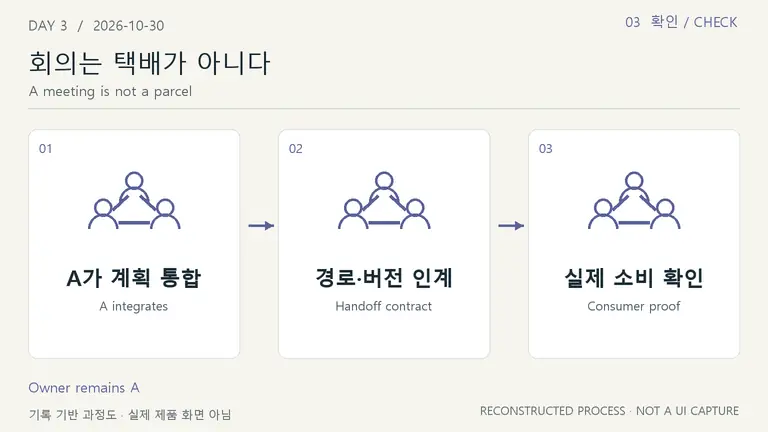
Process 3: A meeting is not a parcelA integrates → Handoff contract → Consumer proof. Editorial diagram reconstructed from the dated records.
Based on actual work; expressions and robot scenes are dramatized. Actual work captures are labelled separately from illustrations.