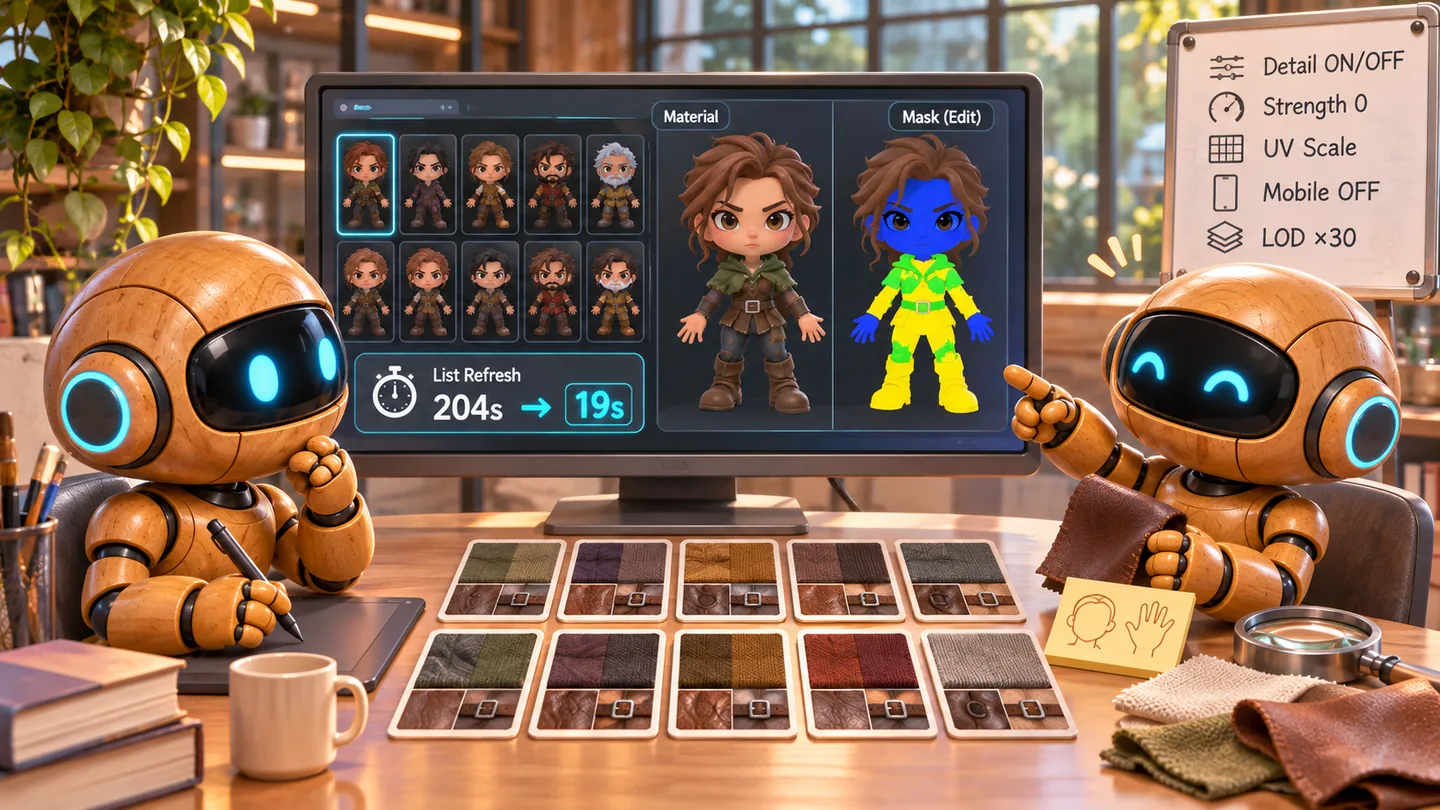
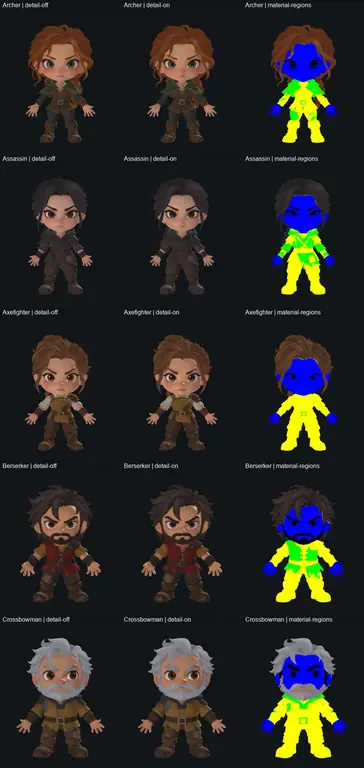
Cloth should look like cloth; leather like leather. Faces were not meant to become upholstery. The character principal applied the new surface-detail effect to ten BanditCamp characters and checked its reach. Their skin regions, at least, had protection.
The first automatic classification mixed cloth and leather and misidentified parts of faces and hands. Existing metal information and clothing colours helped correct boundaries. Finger names such as Index and Middle also caused missed skin detection. A hand should not lose its status over a name tag.
Corrections used calculation copies, preserving original bone names and movement weights. We protected faces, eyes and beards while checking on/off, zero strength, pattern scale, mobile disabling and thirty distance-detail models. Boundaries remain editable drafts. Automatic classification was not promoted to art director.
We also found the list delay: the same evidence and dependency files were fingerprinted repeatedly in one refresh. Reducing duplication changed the measured refresh in that project from about 204 seconds to nineteen. List waiting improved, not game frame rate. Those waiting still had reason to appreciate it.
Checks cover editor rendering and manual motion previews. Device performance, physics and play-mode acceptance are separate. The handoff now clearly assigns post-Unity cleanup, materials and distance-detail checks to the principal. Ten bandits have less reason to wait at the door looking for a department.