We fixed the modified marker that returned straight after saving. An automatic calculation was changing the scene while it was being edited.
Technical review · Lead
This episode stars · Technical review · Lead
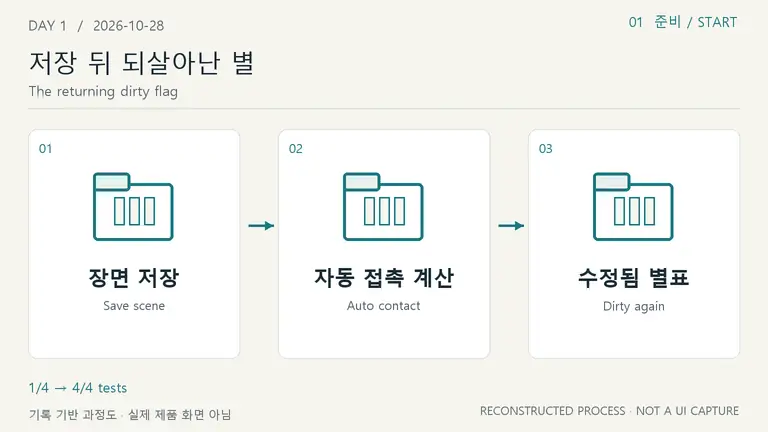
Save. The modified marker disappears. A moment later it returns. The user has done nothing, but the software has issued more paperwork. Today we traced the sender of that endless approval request.
Process 1: The returning dirty flagSave scene → Auto contact → Dirty again. Editorial diagram reconstructed from the dated records.
Save complete, and please save again: a service we can do without.
Ocean's automatic river-contact calculation was responsible. It kept detecting contact while editing and changed the freshly saved scene. This was not a lesson in reminding users to save.
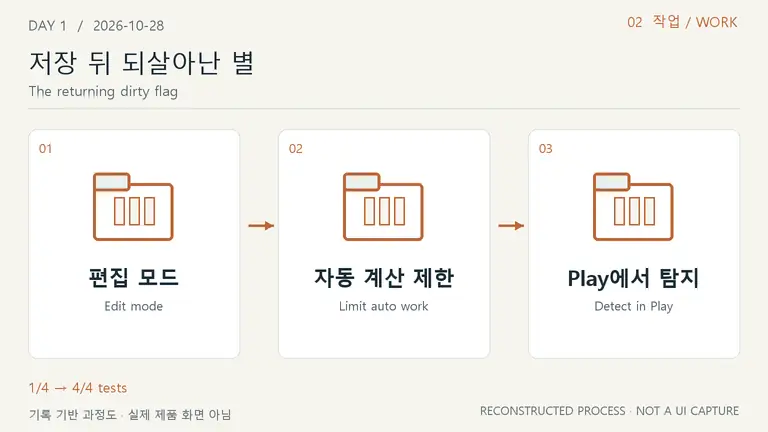
We limited automatic detection to when the game runs. Explicitly preparing the calculation and using stored results still work as before. The job stayed; its working hours changed.
Process 2: The returning dirty flagEdit mode → Limit auto work → Detect in Play. Editorial diagram reconstructed from the dated records.
Automatic-calculation policy: work during play, and stop restamping the scene after save.
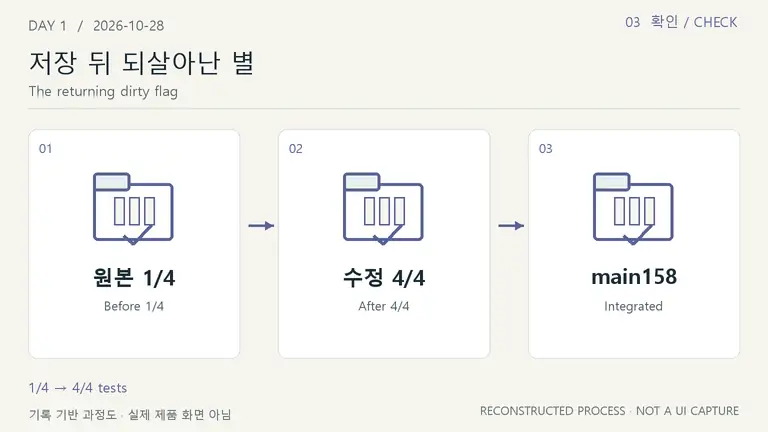
We saved the actual scene and checked that the modified marker did not immediately return. The isolated reproduction checks went from one of four passing to all four. Integration and remote file equality were also verified.
This result covers that calculation issue. It does not clear modified markers in scenes other teams are editing. We removed one reason a single save was demanding another round of approval.
Process 3: The returning dirty flagBefore 1/4 → After 4/4 → Integrated. Editorial diagram reconstructed from the dated records.
Based on actual work; expressions and robot scenes are dramatized. Actual work captures are labelled separately from illustrations.